
Where the Rain Goes After It Leaves Your Roof
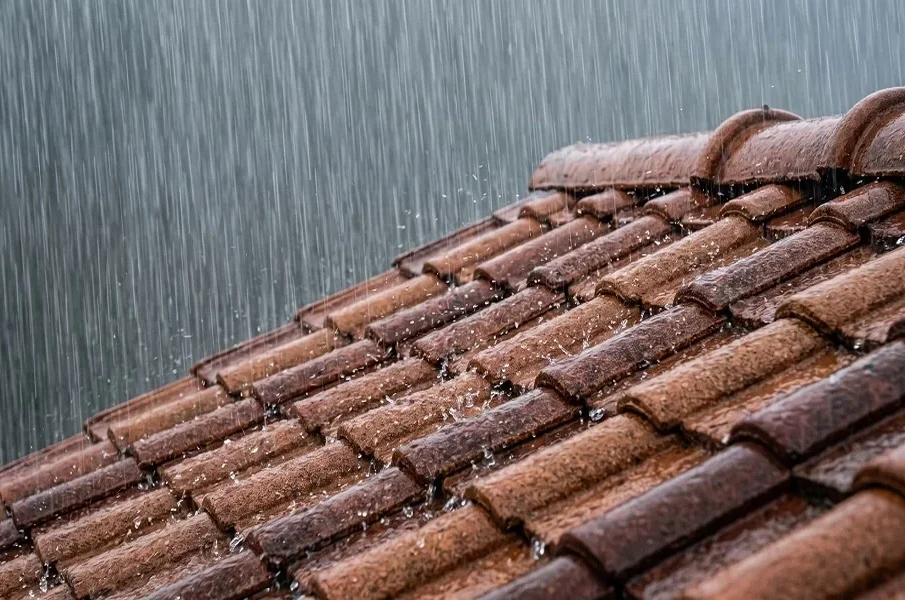
A roof does not end at the shingles. Every storm sends hundreds of gallons of water across the surface, and what happens to that water next decides whether the rest of the house stays dry. When drainage works, you never think about it. When it fails, the damage shows up in strange places: a rotted board at the roof edge, a stained patch of siding, a crack in the foundation. Here are four common drainage case files, each with the clues, the likely cause, and the fix.
Case file one: the gutter that overflows in every storm
The clues: Water spills over the front edge during heavy rain, leaving streaks on the siding or digging a trench in the flower bed below.
The likely causes: Clogged gutters are the usual suspect. Leaves, seed pods, and shingle grit pile up, and the water has nowhere to go but over the side. Other causes include gutters that have lost their slope, downspouts that are too few or too small for the roof area, and valleys where two roof planes dump a large amount of water into one short stretch of gutter.
The fix: Clean the gutters and downspouts at least twice a year and after major storms, and flush them with a hose to see where water backs up. The standard slope is about half an inch for every 10 feet of gutter, according to This Old House, so check that the runs still tilt toward the downspouts. If overflow persists even when the gutters are clean, the system may be undersized for the roof, and a contractor can recommend larger gutters, additional downspouts, or a diverter at the valley.
Case file two: the rotted board along the roof edge
The clues: Peeling paint on the fascia, soft or darkened wood behind the gutter, or stains on the soffit under the eaves.
The likely causes: Water that gets behind the gutter or curls under the shingle edge can soak the fascia and decking for years before anyone notices. Missing drip edge, gaps between the gutter and the fascia, or a gutter that sags away from the house all let water slip into places it should never reach.
The fix: Replace the damaged wood, then correct the cause. The drip edge should extend over the gutter so water lands inside it, and the gutter should be firmly fastened with enough hangers to hold its weight. A roofing company like Texas Roofing Authority LLC can inspect the roof edge, gutters, and fascia together, since a leak at the edge is often a roofing problem and a drainage problem at the same time. Ask for photos of any hidden damage, and for a written description of what will be repaired and how.
Case file three: the puddle beside the foundation
The clues: Water pooling next to the house after rain, soil washed away beneath a downspout, damp walls in a garage or crawl space, or new cracks in drywall near doors and windows.
The likely causes: Downspouts that empty right next to the foundation soak the soil, which can lead to settling, heaving, and cracks. This matters most where the soil swells and shrinks with moisture, a condition common in many parts of Texas.
The fix: Move the water away. The Building America Solution Center, a resource from the Pacific Northwest National Laboratory for the Department of Energy, explains in its guide to gutters and downspouts that these systems should direct rainwater down and away from the home to reduce saturating the soil around the foundation, and that this is especially important with expansive soils. It recommends downspouts that drain at least 5 feet from the foundation, or underground drains that carry water at least 10 feet away.
In practice, that can mean a simple extension for a quick fix or a buried drain line for a permanent one. Also check that the ground slopes away from the house, since a perfect downspout cannot overcome soil that tilts toward the walls.
Case file four: the gutter guard that did not solve everything
The clues: Gutter guards or covers were installed, yet the gutters still clog or overflow.
The likely causes: Guards reduce debris, but they do not eliminate it. Fine particles, pollen, and shingle granules can still collect, and some designs let water shoot over the edge during heavy downpours. Poor installation can also leave gaps where debris gets in.
The fix: Treat guards as a helper, not a cure. Inspect them a couple of times a year, clear what builds up on top, and ask the installer how the product performs in heavy rain and with the type of trees near your house. Before you buy, request the manufacturer’s warranty details and ask whether the guard can be removed for cleaning or repairs.
Closing the case files
Each of these cases comes down to the same principle: water has to be collected at the roof edge, carried through the gutters and downspouts, and released far enough from the house that it cannot cause harm. Clean the system on a schedule, keep the gutters sloped and firmly attached, make sure the roof edge details work with them, and move the discharge point away from the foundation.
A good habit is to watch the system during a real rainstorm. Stand outside, or look out a window, and see where the water goes. Overflow, drips behind the gutter, and puddles near the walls will tell you more in ten minutes than a month of guessing. Fix the small things early, and call a professional when the cause is hidden or the repair involves the roof itself. Drainage is not glamorous, but it is the quiet system that protects everything else you have spent money on.