
The Rise of Matte Finishes in Commercial Restrooms: Gloss Levels, Fingerprints, and Design Intent
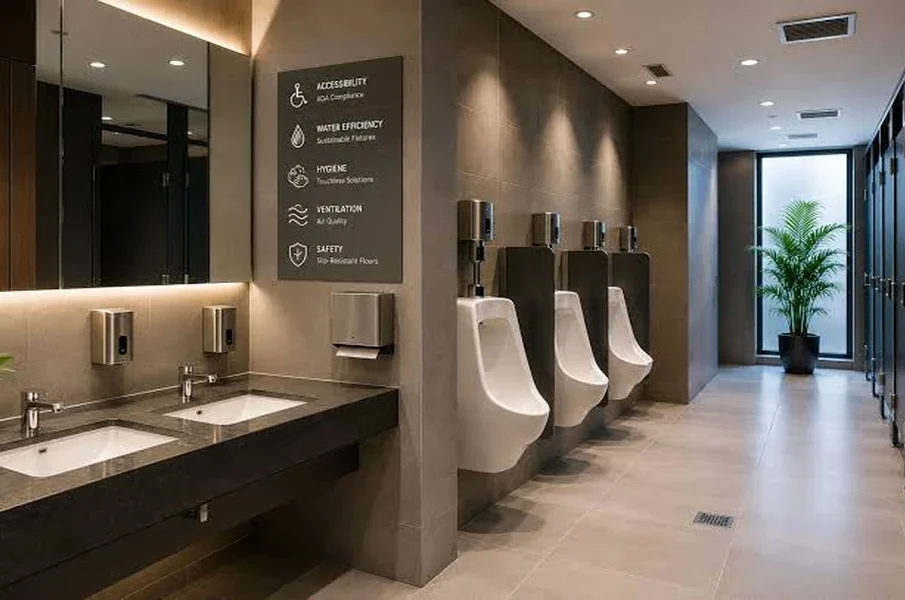
Matte surfaces have spread from residential kitchens into commercial interiors, and restroom partitions are following the same path. Designers are choosing lower sheen to soften large surfaces, reduce glare under bright lighting, and give restrooms a calmer, more architectural feel. The shift raises practical questions about how gloss is measured and how matte finishes behave in heavy daily use.
How is surface gloss measured?
Surface gloss is measured with a glossmeter that records how much light reflects from a surface at a defined angle. The widely used test method specifies measurements at 20, 60, and 85 degrees depending on how glossy the surface is (ASTM International). Results are reported in gloss units, giving designers a number to specify instead of a subjective description.
Why does the measurement angle matter?
The angle matters because high-gloss and low-gloss surfaces are read most accurately at different geometries. Low-sheen finishes are often checked at the shallow 85-degree angle, where differences between matte and satin become easier to detect.
What is driving demand for matte partitions?
Demand for matte partitions comes from designers who want restrooms to match the rest of the interior. Manufacturers have responded by introducing matte powder coated partitions alongside standard finishes, extending the low-sheen look to one of the largest surfaces in the room (ASI Accurate Partitions).
How does matte change the look of a restroom?
Matte changes the look by absorbing more light and reflecting less glare. Under the bright downlights common in restrooms, a lower sheen hides minor surface waviness and makes colors read richer and more consistent from one compartment to the next.
How do matte finishes handle fingerprints and wear?
Matte finishes handle fingerprints well because they reflect less light, so smudges are less visible from a distance. Daily cleaning still matters, and facility teams should follow the manufacturer’s care instructions to preserve the original sheen.
Which cleaning habits protect a matte finish?
Four cleaning habits help a matte finish keep its appearance:
- Using neutral cleaners rather than abrasive powders
- Wiping with soft cloths instead of scouring pads
- Rinsing cleaning residue that can leave visible film
- Testing new chemicals on a small area first
Why does powder coating suit restroom environments?
Powder coating suits restroom environments because it creates a durable, cured film without the solvents used in many liquid paints. Powder coatings contain essentially no volatile organic compounds (Powder Coating Institute). That matters indoors, where concentrations of many volatile organic compounds can run up to 10 times higher than outdoors (Environmental Protection Agency).
How does the coating process affect durability?
The powder is electrostatically applied and then heat cured, forming a continuous layer across the steel. That process produces even coverage on edges and corners, where restroom partitions take the most contact from users and cleaning tools.
Where do matte partitions fit best?
Matte partitions fit best in offices, hospitality, and cultural buildings where restrooms are expected to match surrounding finishes. They pair well with matte black or brushed hardware, stone-look counters, and warm lighting. Designers can also mix matte partitions with stainless accessories for contrast.
How do matte partitions pair with other restroom elements?
Matte partitions pair best with a restrained palette of finishes. Designers often repeat the low sheen in wall tile, countertops, and hardware so the restroom reads as one composition. Mixing a matte partition with high-gloss tile can work, but the contrast should be intentional, with lighting placed to avoid harsh reflections on the glossier surfaces.
Do matte finishes suit every color?
Matte finishes suit deep and muted colors especially well, including charcoal, black, and earth tones that can look plastic in high gloss. Lighter colors also work but show less dramatic change, so samples under the project’s actual lighting are the best way to judge the result.
What should specifiers include?
Specifiers should name the finish, color, and any target gloss range directly in the partition section, and request physical samples before approval. Clear documentation ensures the matte look in the rendering is the matte look delivered on site.